Relational Database Data Import (CSV)
The objective of this project was to use MySQL to import, clean, and transform a raw video game sales dataset into a structured, reliable database that supports efficient querying and business analysis.
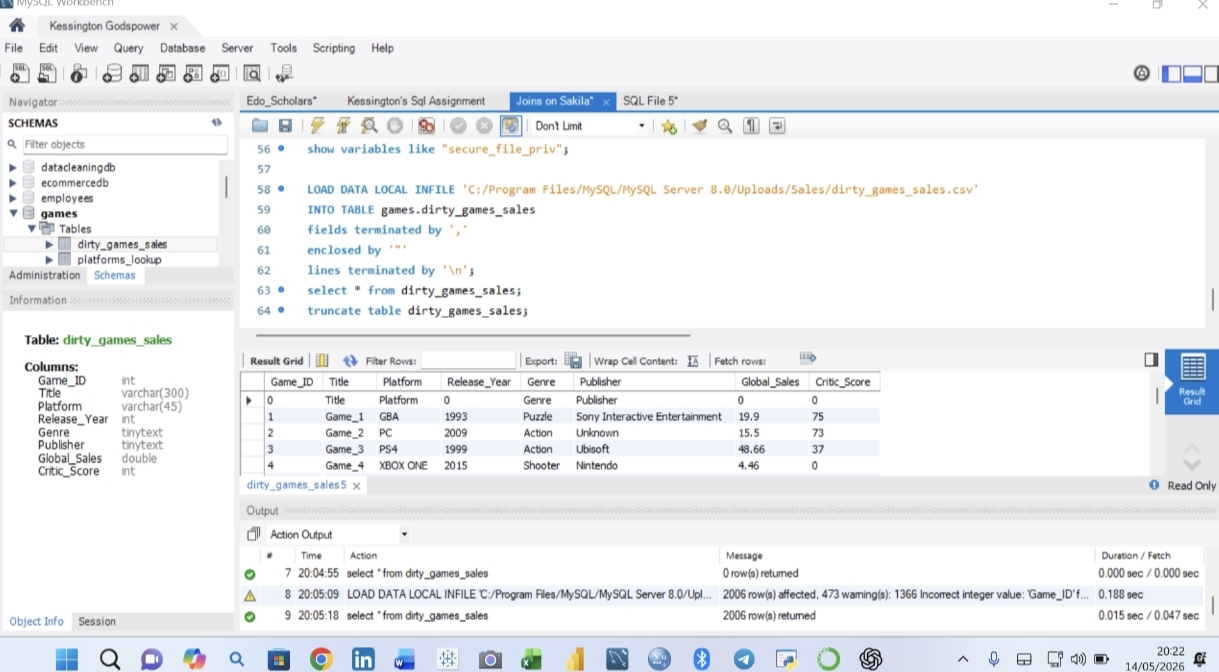
Problem: Organizations often work with large datasets that contain duplicate records, missing values, inconsistent formats, and invalid entries, making accurate analysis difficult. The objective of this project was to use MySQL to import, clean, and transform a raw video game sales dataset into a structured, reliable database that supports efficient querying and business analysis.
Key business questions addressed include:
- How can raw CSV data be imported into a relational database efficiently?
- How can inconsistent and incomplete records be identified and cleaned?
- How can SQL be used to prepare data for analysis and reporting?
- How can database operations improve data quality and integrity?
Process:
- Created a relational database and defined the required table schema in MySQL.
- Imported the raw CSV file into the database using the LOAD DATA LOCAL INFILE command.
- Validated the imported data by querying the table and checking for import errors and warnings.
- Cleaned the dataset by:
- Handling missing and null values
- Correcting inconsistent data type
- Removing invalid records -Standardizing text fields
- Performed SQL operations to inspect and transform the data using: -SELECT -WHERE -UPDATE -DELETE -TRUNCATE -Aggregate functions
- Verified data quality through validation queries to ensure the dataset was ready for analysis.
- Prepared the cleaned database for downstream reporting and analytics.
Lessons Learned -Data quality has a significant impact on the accuracy of analytical results. -Importing large datasets into MySQL requires careful attention to data types, delimiters, and formatting. -SQL is a powerful tool for cleaning, validating, and transforming raw data efficiently. -Query validation helps identify errors early and ensures database integrity. -Well-structured databases improve performance, maintainability, and scalability for future analysis. -Understanding database operations is essential for building reliable data pipelines and supporting business intelligence initiatives.
Skills Demonstrated MySQL SQL Query Writing Database Design Data Import and Export Data Cleaning and Transformation Data Validation CRUD Operations Relational Database Management Data Quality Assurance ETL Fundamentals Analytical Problem Solving