Data Modelling
The objective of this project was to design a star schema data model in Power BI by establishing relationships between sales, customer, and product tables.
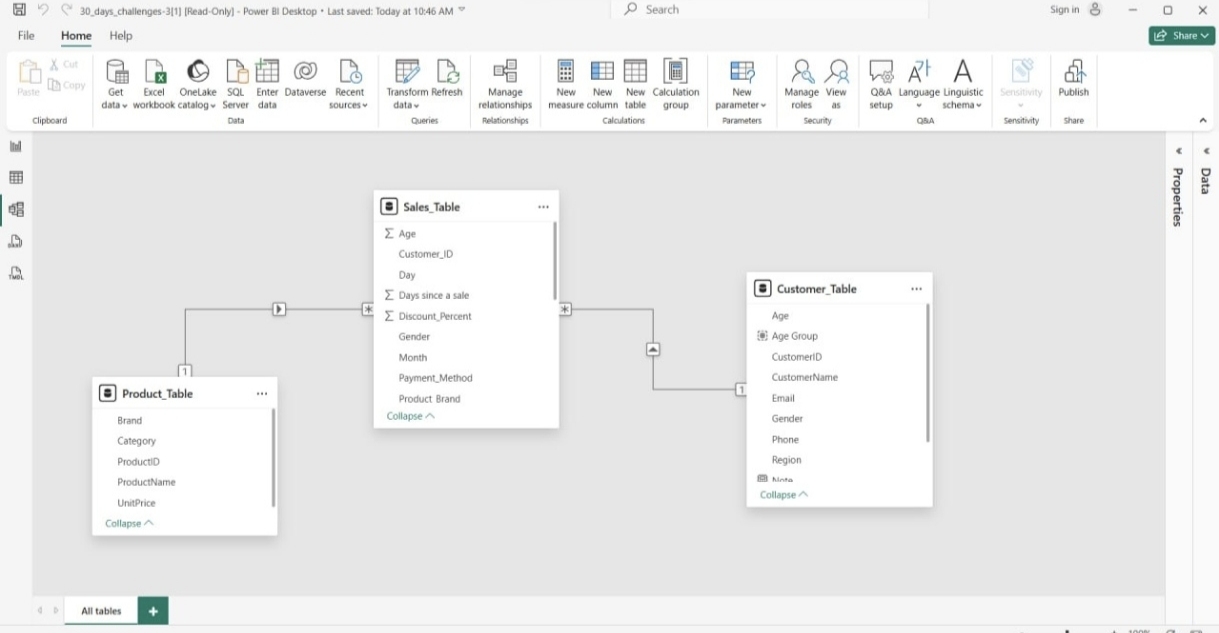
Problem: Businesses often store sales, customer, and product data in separate tables, making it difficult to generate unified reports and accurate business insights. The objective of this project was to design a star schema data model in Power BI by establishing relationships between sales, customer, and product tables. This provides a scalable foundation for efficient reporting, accurate calculations, and interactive business intelligence dashboards.
Key business questions addressed include:
- How can multiple datasets be connected for unified analysis?
- How can relationships improve data consistency and reporting accuracy?
- How can an optimized data model support faster dashboard performance?
- How can customer, product, and sales data be analyzed together to generate meaningful insights?
Process:
- Imported the Sales, Customer, and Product datasets into Power BI.
- Cleaned and transformed the data using Power Query by correcting data types, removing duplicates, and handling missing values.
- Identified primary and foreign keys across the datasets, including: -Customer ID -Product ID
- Built a relational data model by creating one-to-many relationships between:
- Product Table → Sales Table
- Customer Table → Sales Table
- Configured relationship cardinality and cross-filter directions to ensure accurate data filtering and aggregation.
- Validated the model by testing relationships with sample visualizations and verifying that filters propagated correctly across tables.
- Optimized the model to support future DAX measures, KPIs, and interactive dashboards.
Lessons Learned:
- A well-designed data model is the foundation of every successful Power BI report.
- Establishing proper relationships eliminates data redundancy and improves reporting accuracy.
- Star schema modeling enhances query performance and simplifies dashboard development.
- Understanding primary keys, foreign keys, and relationship cardinality is essential for building scalable business intelligence solutions.
- Data modeling enables seamless analysis across multiple datasets without manual data merging.
- Proper model validation ensures reliable calculations and consistent dashboard behavior.
Skills Demonstrated Microsoft Power BI Data Modeling Star Schema Design Relational Database Concepts Power Query (ETL) Data Cleaning and Transformation Relationship Management Data Integration Business Intelligence Analytical Problem Solving Dashboard Data Architecture